Rank in AI
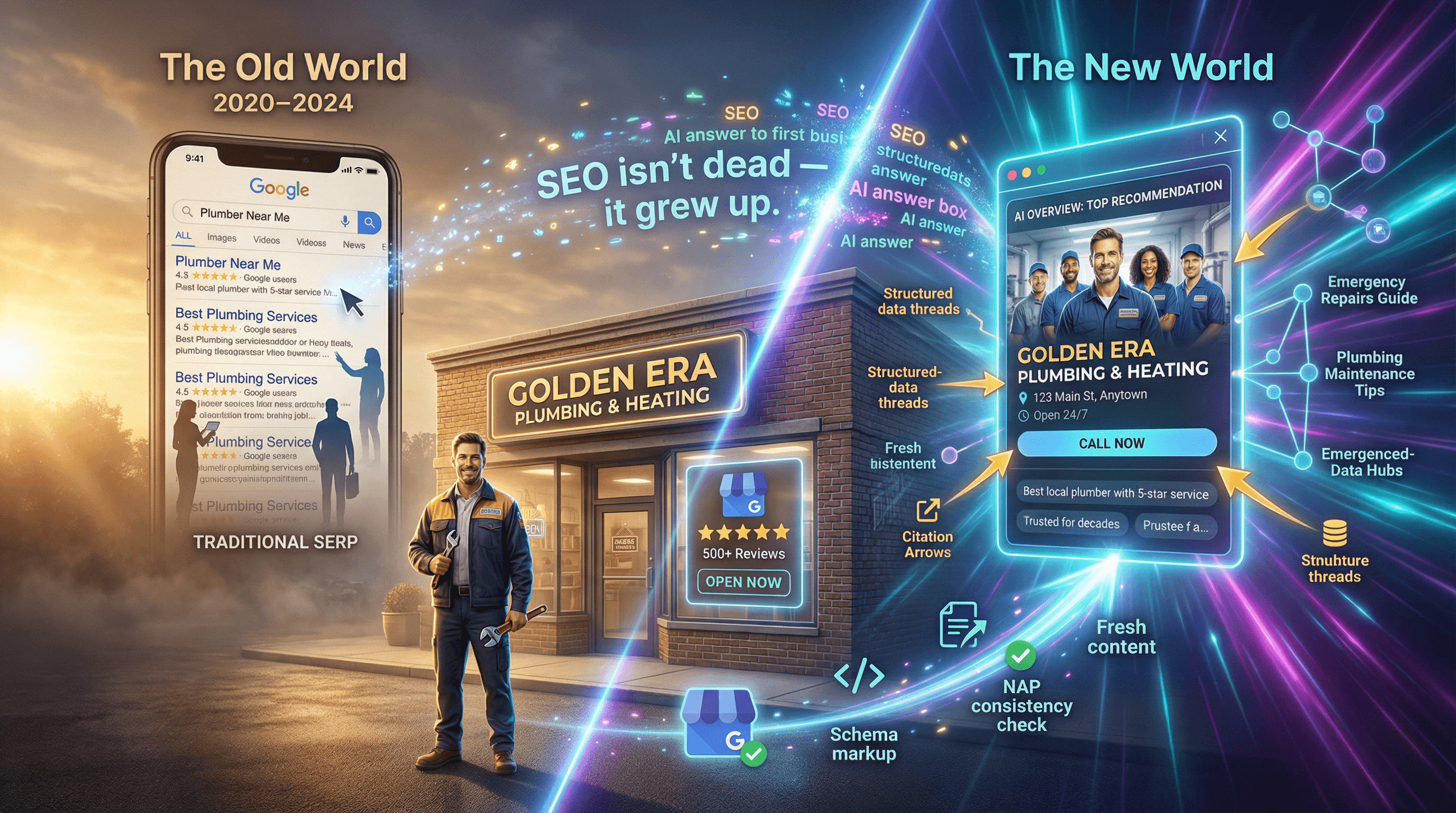
Is SEO dead? Learn why traditional SEO is evolving, not dying, and how to adapt your strategy for ranking in AI search results. Avoid the GEO mistake.
You might be hearing a lot of noise lately about how SEO is finished, kaput, gone forever because of AI. It’s like every other year, someone declares the end of something that’s just changing. This time, it’s SEO, and the culprit is AI search. But here’s the real deal: it’s not dead, it’s just growing up. Local businesses, especially, need to pay attention because missing this shift could mean losing customers without even knowing why.
Key Takeaways
SEO isn't dead, it's evolving into new forms like GEO (Generative Engine Optimization) and AEO (Answer Engine Optimization) to adapt to AI search.
AI Overviews and zero-click searches are reducing clicks on traditional links, making it important to be cited within AI answers.
Traditional SEO principles like content quality, authority, and technical optimization are still vital for ranking in AI.
Local SEO elements, such as Google Business Profiles and NAP consistency, remain highly relevant and are crucial for LLMs to find local business information.
Adapting to AI search involves understanding new tactics like structured data and monitoring AI outputs, while leaning on established SEO experience.
The AI Search Revolution: Understanding the New Landscape
Generative Engine Optimization (GEO) Explained
The way people find information online is changing, and fast. It’s not just about typing keywords into Google anymore. Large language models, or LLMs, are stepping in, offering a different way to get answers. Think of it like asking a really smart assistant instead of flipping through a phone book. These AI tools can pull information from all over the web – forums, social media, even your company’s cloud documents – to give you a direct answer. This shift means we need new ways to make sure our content gets seen by these AI systems. That’s where Generative Engine Optimization, or GEO, comes in. It’s about adapting your content so it’s understandable and useful to AI models, not just traditional search engines. It’s a new layer on top of what we already know about SEO.
Answer Engine Optimization (AEO) and LLMO
Beyond just getting content found by AI, there’s also the idea of Answer Engine Optimization, or AEO. This focuses on making sure your information is the kind of thing an AI will actually use to answer a question. It’s about providing clear, concise, and authoritative answers that AI models can easily digest and present to users. Think about it: if an AI is going to give a direct answer, it needs to pull from reliable sources. AEO is about becoming that reliable source. This ties into what some call LLMO, or Large Language Model Optimization. It’s the practice of structuring and presenting your information in a way that LLMs can best process and utilize. This involves understanding how these models work, what kind of data they prefer, and how they synthesize information. It’s a more technical side of making your content AI-friendly.
Why Traditional SEO Isn't Dead, But Evolving
Now, I know what some of you might be thinking: "Is SEO dead?" It’s a question that’s been buzzing around a lot lately, especially with all the AI hype. But here’s the thing: traditional SEO isn't gone. It's just changing. Google still processes billions of searches every day, and many people still prefer it for quick, factual questions. The core principles of good SEO – creating helpful content, understanding your audience, and building authority – are still super important. What’s different is how that information gets presented. AI overviews and direct answers are showing up at the top of search results, pushing the classic "blue links" down. This means we need to adapt. We can’t just ignore AI. Instead, we need to figure out how to make our existing SEO efforts work better within this new AI-powered search landscape. It’s about evolving, not abandoning. The goal remains connecting users with the best information, no matter the format. For businesses, this means understanding how conversational AI is transforming how potential customers find them online [5697].
Here’s a quick look at how search is changing:
AI Overviews: AI-generated summaries appear at the top of search results, often providing answers directly.
Zero-Click Searches: Users get their answers from the AI overview, meaning they don't need to click through to a website.
Shifting User Behavior: While some users trust AI answers, others still look for traditional links, showing that authoritative content still matters.
The search engine results page (SERP) is becoming a more dynamic space. AI is adding new layers of information and interaction, changing how users find and consume content. This isn't the end of SEO, but a significant evolution that requires a strategic adjustment.
The Misconception: Why 'SEO is Dead' is a Costly Mistake
You hear it everywhere, right? "SEO is dead!" It's like a broken record that plays every few years, especially when something new and shiny like AI comes along. This time, the AI search revolution has everyone shouting it from the rooftops. But honestly, it's a bit of a panic-driven narrative, and believing it could actually cost your business. Think about it – Google still holds a massive chunk of the search market. People aren't just not searching anymore; they're searching differently, and that's where the confusion lies.
The Hype Cycle of AI and Search
We're definitely in a hype cycle right now. AI is the hot new thing, and naturally, people are jumping to conclusions. It reminds me a bit of when social media first blew up, or when mobile-first indexing became a thing. Everyone freaked out, saying old ways wouldn't work anymore. But here's the thing: the core principles usually stick around, they just get a new coat of paint. AI search is no different. It's not about replacing what worked, but about adding new layers to it. Many of the "experts" suddenly appearing with revolutionary AI solutions are often just rehashing old tactics or are themselves AI-generated entities with no real-world experience. They prey on the urgency and fear that comes with new technology.
The Impact of AI Overviews on Click-Through Rates
Okay, so AI Overviews and AI Mode are changing things. Instead of a list of blue links, you often get a summarized answer right at the top. This does mean fewer people are clicking through to individual websites. Studies show that when an AI summary is present, click-through rates to traditional links can drop significantly. For example, one analysis showed clicks falling from around 15% to just 8% when an AI overview was shown. That's a big hit. But does this mean SEO is dead? Not at all. It just means you need to figure out how to get cited within those AI answers, not just rank above them.
Zero-Click Searches and Their Growing Prevalence
Related to AI Overviews, we're seeing more "zero-click" searches. This is where users get their answer directly from the search results page without needing to click on any links. Some reports suggest that a significant portion of searches now result in zero clicks. This can lead to a noticeable drop in organic traffic, sometimes estimated between 15-25%. It sounds scary, but it's really just another evolution. The goalposts have moved. Instead of just aiming for that top blue link, you're now also aiming to be the source material for the AI's answer, or to appear in other prominent spots on the results page. It's about adapting your strategy to be visible in this new landscape, not abandoning your efforts altogether.
Adapting Your Strategy for Ranking in AI

The search engine world is changing, and fast. It’s not about abandoning what worked before, but rather tweaking your approach to fit how AI systems now find and present information. Think of it like this: you still need to build a solid house, but you might need to use slightly different tools and materials depending on the climate.
Leveraging SEO Fundamentals for AI Visibility
It’s easy to get caught up in the AI hype and think everything we knew about SEO is useless. That’s just not true. The core ideas behind good SEO are still super important. AI models are built to understand and process information, and they still rely on many of the same signals that traditional search engines did. So, what does this mean for you?
Clear, Direct Content: Write like you're explaining something to a friend. Use plain language and get straight to the point. AI likes content that answers questions directly.
Natural Language Keywords: People aren't just typing in short phrases anymore. They're asking full questions. Make sure your content includes these longer, more conversational keyword phrases.
Site Structure Matters: Just like before, a well-organized website helps AI crawlers understand your content. Use headings, subheadings, and clear navigation.
The goal isn't to trick the AI, but to make your content so clear and helpful that the AI wants to use it. It’s about being the best answer, presented in a way the AI can easily digest.
The Role of Content Freshness and Authority
AI systems, especially those connected to live search, are programmed to look for what's current. If someone asks about the latest trends or news, the AI will naturally lean towards more recent information. This means keeping your content updated is more important than ever.
Regular Updates: Go back to your important articles and add new data, examples, or insights. Even small updates can signal to AI that your content is still relevant.
Build Trust: AI models are trained on vast amounts of data, and they learn to identify reliable sources. Earning backlinks from reputable sites and getting mentions on well-known platforms helps build your authority. Think of it as getting a good recommendation from a trusted source.
Optimizing for AI-Generated Answers
AI overviews and generative answers are becoming common. This means your content might not just be a link on a page; it could be part of the answer itself. How do you make sure your business or information gets included?
Structured Data: Use schema markup. This is like adding labels to your content that tell AI exactly what it is – a recipe, an FAQ, a how-to guide. This makes it much easier for AI to pull specific information.
Answer Questions Directly: Create content that specifically addresses common questions your audience might ask. FAQ sections or Q&A formats are great for this.
Monitor AI Outputs: Actually check what the AI is saying. Use tools that track how your brand is mentioned in AI responses. This gives you real-time feedback on what's working and where you might be missing out.
The GEO Mistake: Overlooking Local Business Essentials
It’s easy to get caught up in the shiny newness of AI search, thinking everything we knew about getting found online is suddenly obsolete. But here’s the thing: for local businesses, many of the old rules still apply, and in some ways, they’re more important than ever. The idea that Generative Engine Optimization (GEO) means we can forget about local SEO is a big, costly misunderstanding.
Local SEO's Enduring Relevance in AI Search
Think about how people search for local services. They need a plumber now, a restaurant tonight, or a mechanic this afternoon. These are immediate, location-based needs. While AI can synthesize information, it still needs solid, real-world data to provide relevant local answers. AI models are trained on vast datasets, and for local queries, that data often comes from established local business listings and directories. Ignoring these foundational elements means your business might simply not show up when someone nearby is looking for what you offer.
Google Business Profiles and NAP Consistency
Your Google Business Profile (GBP) is like your digital storefront for local search. It’s where customers find your hours, address, phone number, and reviews. For AI, this information is gold. If your Name, Address, and Phone number (NAP) are inconsistent across the web – maybe one listing has "St." and another has "Street," or the phone number is slightly different – AI tools get confused. This confusion can lead to your business being overlooked or, worse, misrepresented. Keeping your NAP information identical everywhere is a simple but powerful way to build trust with search engines and, by extension, with AI systems.
Here’s a quick check for NAP consistency:
Name: Is your business name exactly the same everywhere?
Address: Is the street address format identical (e.g., "123 Main St." vs. "123 Main Street")?
Phone Number: Is the phone number format consistent (e.g., (555) 123-4567 vs. 555-123-4567)?
Why Local Data is Crucial for LLMs
Large Language Models (LLMs) are getting smarter at understanding context. When someone asks, "Find a good pizza place near me," the LLM needs to access and process local data. This includes:
Geographic proximity: Understanding where "near me" actually is.
Business categories: Knowing that "pizza place" means a restaurant.
Reputation signals: Considering reviews and ratings.
Operational details: Checking if the business is open.
This kind of information is precisely what local SEO has focused on for years. Without accurate, well-structured local data, LLMs can't provide the specific, actionable answers that local customers demand. It’s not about complex AI prompts; it’s about making sure the basic, factual information about your business is readily available and correct.
The rush to adopt new AI optimization tactics can sometimes blind businesses to the enduring power of foundational local search signals. Think of it like building a futuristic smart home – you still need a solid foundation and reliable plumbing, not just the latest smart gadgets.
Beyond the Hype: Genuine AI Search Optimization Tactics
Okay, so AI search is here, and it's changing things. But before you toss out everything you know about SEO, let's talk about what actually works. It’s not about chasing the latest buzzword; it’s about making sure your business shows up when people need it, no matter how they're searching. This means focusing on solid tactics that help AI systems understand and trust your information.
The Importance of Structured Data
Think of structured data as a way to give AI a clear roadmap to your content. It’s like labeling your ingredients for a recipe so anyone can follow along easily. Using schema markup, for example, tells search engines and AI exactly what your page is about – is it a product, a service, an event, or an FAQ? This makes it much simpler for AI to pull the right information and present it accurately. It’s not just about keywords anymore; it’s about making your content machine-readable.
Use FAQ schema for question-and-answer pages.
Implement HowTo schema for step-by-step guides.
Employ Article schema for blog posts and news content.
Monitoring AI Outputs for Brand Presence
So, how do you know if your efforts are paying off in this new AI landscape? You need to watch what the AI is actually saying. Instead of just tracking clicks, you should be monitoring where your brand or website is mentioned in AI-generated answers. This gives you a real-time look at your visibility. Some tools can automate this, checking AI responses for your keywords and brand name regularly. It’s a bit like checking your reputation, but for algorithms.
The goal isn't just to be found; it's to be recognized and cited by AI as a reliable source. This requires a consistent presence and clear messaging across the web, so AI has a strong signal to work with.
Building Topic Hubs and Primary Sources
AI models often pull information from multiple places to form an answer. If you want to be one of those places, you need to be the go-to source. This means creating in-depth content that covers a topic thoroughly. Instead of just a single blog post, think about building a
Why SEO Professionals Lead the AI Search Charge
Look, the whole "SEO is dead" thing? It's mostly noise. Sure, search is changing, and AI is a big part of that. But if you've been doing SEO for any length of time, you've seen these kinds of shifts before. Remember when mobile-first was going to kill everything? Or voice search? They changed things, yeah, but they didn't kill SEO. They just made SEO pros adapt.
Navigating Daily Changes with SEO Expertise
SEO folks are basically professional adapters. We've spent years figuring out how search engines work, how algorithms change, and how users search. We've learned to optimize for all sorts of things – not just websites, but apps, images, videos, and local listings. AI search is just the next puzzle to solve. It's not a completely new game; it's more like a new rulebook for an old game we already know how to play. The skills we've built – understanding keywords, content quality, user intent, and technical site health – are still super important. They're the foundation for whatever comes next.
The Value of Experience in Evolving Search
Think about it. We've seen "SEO killers" come and go for decades. Each time, the sky wasn't falling. Instead, SEO professionals figured out how to work with the new features. We learned to optimize for things like Google's Knowledge Graph, featured snippets, and now, AI Overviews. It's about understanding what the search engine is trying to do and how to make your content fit that goal. The people shouting "SEO is dead" are often the ones who didn't really get it in the first place, or they're trying to sell you something new and shiny.
From Blue Links to AI Answers: A Seamless Transition
So, what does this mean for you? It means the core principles of good SEO are still your best bet. High-quality, relevant content that answers user questions clearly? That's what AI is looking for too. Having a well-structured website with good authority? Still matters. Local businesses, especially, need to remember that AI models often pull from the same reliable local data sources that traditional SEO has always focused on. It's not about abandoning what works; it's about understanding how those winning strategies apply to the new AI-driven search landscape. The pros are the ones who can see this evolution, not panic and throw out everything they know.
So, What's the Real Takeaway?
Look, the whole 'SEO is dead' thing? It's mostly noise. Sure, things are changing fast with AI, and if you're just doing the same old stuff you did five years ago, you're probably going to get left behind. But that doesn't mean all that work you put into your website, your content, and your local listings is suddenly useless. It's more like an upgrade is needed. Think of it like this: your business is still the same, but how people find you is getting a makeover. Focusing on making your business info super clear, especially for local searches, and making sure your website actually helps people is still the name of the game. Don't fall for the hype that you need a whole new magic trick; just learn how to use your existing tools in this new AI landscape. Your customers are still out there looking, and they'll find you if you adapt.
Frequently Asked Questions
Is SEO really dead because of AI?
No, SEO isn't dead! Think of it like this: SEO is like riding a bike. It used to be you rode on dirt roads, but now there are also paved highways. SEO is just learning to ride on those new highways too. The basic idea of helping people find what they need online is still the same, but how we do it is changing to include AI tools.
What is GEO and how is it different from SEO?
GEO stands for Generative Engine Optimization. It's basically SEO for AI-generated answers. Instead of just trying to get your website to show up as a blue link, GEO focuses on making sure your information is used and shown in the answers that AI gives, like in Google's AI Overviews. It's SEO, but with a focus on these new AI responses.
Why do people say SEO is dead?
People say SEO is dead because AI tools, like ChatGPT and Google's AI Overviews, are giving direct answers. This means fewer people might click on regular website links. Also, 'zero-click' searches, where people get their answer without clicking anywhere, are becoming more common. It feels like a big change, but it's more about SEO changing than disappearing.
How does AI affect local businesses and their SEO?
AI is actually making local SEO even more important! AI tools often pull information from places like Google Business Profiles and local directories. So, making sure your business information (like name, address, and phone number) is correct and consistent everywhere is super important. It helps AI understand and show your business to people looking for local services.
What's the biggest mistake businesses make with AI search?
A big mistake is thinking that old SEO tricks will work for AI, or completely ignoring local business details. Many AI tools rely on solid, trustworthy information. If you just try to trick the AI or forget the basics like keeping your business info up-to-date and consistent, you'll miss out. Local details are crucial for AI to find and trust your business.
How can I make sure my business is seen in AI search results?
You need to do a few things. First, keep your basic SEO strong: create helpful content, make sure your website is easy for search engines to understand, and build your site's authority. Then, focus on AI: make sure your business details are correct everywhere (like your Google Business Profile), use clear language in your content, and consider using structured data to help AI understand your pages better. It's about adapting your existing SEO skills for the new AI world.